SoC Lead Time and Second Sources: Designing Around Single-Chip Risk
“When can we get this SoC?” has become a standing item in hardware kickoff meetings. But what actually determines whether a project ships on time is rarely how well procurement negotiates — it is whether the design left room for an alternative.
Four causes of long lead times, four different responses
Treating lead time as a generic “shortage” is the fastest way to miss the point. There are at least four distinct causes, and they do not share a fix.
The first is wafer and packaging capacity. This kind of shortage is systemic and hits every part on the same process node; changing supplier does not help, and you can only wait for capacity or move to another node. The second is vendor product strategy — shifting capacity toward higher-margin parts, or declaring a part end-of-life. These usually come with a defined timeline, so the last-time buy can be planned. The third is channel hoarding, where hot parts are marked up in the spot market while factory lead times are actually normal; this requires keeping the direct and spot channels strictly separate. The fourth is forecast distortion — customers submit inflated forecasts and the material plan misaligns, which is fundamentally an internal process problem.
Once the cause is identified, the response has somewhere to land: capacity problems need design-level alternatives, EOL needs timeline management, channel problems need supply-channel discipline, and forecast problems need a rolling forecast process.
Three tiers of alternatives, an order of magnitude apart in cost
Pin-to-Pin compatibility is the ideal tier: swap the part on the same PCB with no re-spin and no recertification. Be careful though — the term is used loosely in practice. Many “compatible” claims only cover power and some high-speed interfaces, while MIPI lane counts, PCIe lane allocation and USB 3.0/2.0 multiplexing may differ between parts. After receiving a compatibility claim, compare the datasheets pin by pin rather than concluding from an identical package size. Re-spins caused by “assumed compatible” are not rare.
The second tier is down-binning within the same family — eight cores to six, or a smaller memory configuration, with no PCB change and only reduced performance. This is the most practical tier in an emergency because the software barely moves and customers accept a temporary performance concession. The precondition is that the design did not already run the CPU at its limit; if it did, down-binning means it no longer works.
The third tier is changing platforms, the most expensive, involving a board re-spin, a new BSP and fresh certification, typically measured in months. Its value is therefore not emergency response but planning a dual platform up front: pick a primary and a secondary platform at kickoff and keep the software abstraction layer identical across both.
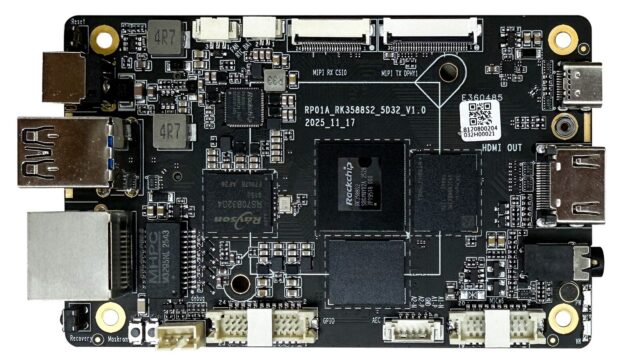
Solutions delivered as a system-on-module, such as the 01A RP01A-RK3588S-5D32 SoM, have a natural advantage here: the carrier board is usually the customer’s own generic design, so swapping a module is far less work than swapping a whole mainboard, and the interface definition tends to stay stable.
Dual-platform design is a software problem, not a hardware one
Many teams fail at dual-platform not because the hardware is late but because the software is hard-wired to one SoC. The usual culprit is putting vendor-specific register access, clock tree configuration or interrupt controller details directly into application code — changing platform then means a rewrite.
A practical approach is a thin abstraction layer between BSP and business logic: unify GPIO, I2C, SPI and PWM access behind one set of internal interfaces, and let application code call only those. Swapping platforms then means rewriting the implementation layer alone. The layer does not need to be heavy — a few dozen functions suffice — but it must exist on day one; retrofitting it after the application is written costs an order of magnitude more.
Peripheral selection matters too. Prefer generic parts available from multiple suppliers (USB-to-serial bridges, Ethernet PHYs) over single-source specialised parts. Modules such as the 01M M-RK3588S SoM fix the common peripherals on the module itself, leaving only the customer-specific interfaces on the carrier board and reducing the number of parts that need alternative validation.
Material locking and safety stock: when to place the order
Locking material early depends on a credible rolling forecast. A workable rule: order long-lead parts against 6 to 12 months of demand, and roll short-lead parts on a 1 to 2 month cycle. Long-lead parts typically include the SoC, DDR, eMMC, dedicated power ICs and custom connectors.
Safety stock is not a guess. Estimate it from two dimensions: replenishment lead time and demand volatility. The quantity is roughly “average consumption over the lead time plus a volatility buffer”. If replenishment takes 12 weeks and demand swings by thirty percent, safety stock should be at least 12 weeks of consumption plus thirty percent.
One frequently overlooked point: put the EOL notification obligation into the purchase contract. Reputable vendors notify 6 to 12 months before discontinuation and provide a last-time-buy window. Without a contractual obligation, you may learn about a discontinuation only after supply has dried up — with no last-time-buy opportunity left.
Make lead-time risk a standing item in design review
The most effective move is to formalise it: Does this SoC have a pin-compatible alternative? Is there a down-binned part in the same family? Is there a second platform? What is the EOL policy? Asking these before committing to a design is far cheaper than firefighting later. For industrial projects that need long-term supply, these questions arguably belong ahead of price — a supply interruption costs far more than a per-unit price difference.
Where a project does need to move between platforms, product lines in the same family and form factor, such as the 02A EDGE-RK3576 V1.1, keep the mechanical changes to a minimum.
Conclusion
Lead-time risk is a design problem, not a procurement one. Identify the cause, prepare alternatives across three tiers — pin-compatible, down-binned, platform swap — establish the software abstraction layer and dual-platform plan at the start, then control material rhythm with rolling forecasts and safety stock. If a chip really does go short, the project slows down instead of stopping.