RK3588 vs RK3588S: Same Architecture, Different Positioning
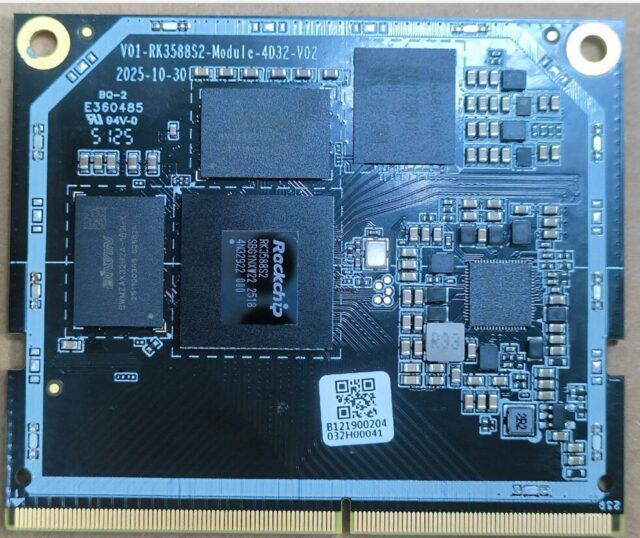
RK3588 and RK3588S are often treated as a high-end and low-end version of the same chip. They are indeed the same generation, with the same eight-core CPU (4×Cortex-A76 + 4×Cortex-A55) and the same 6 TOPS NPU — but the differences concentrate in high-speed interface counts, and that is precisely what decides whether a project ships.
Where they are identical: compute and codecs
Compute capability is essentially the same: 8nm process, eight-core CPU, an NPU supporting RKNN and TensorFlow Lite, and 8K decode with multi-channel encoding on the video side. If a project simply needs a main processor that runs AI inference and handles multiple video streams, the two are indistinguishable on the question of whether it can cope.
In other words, do not focus your selection on compute. The real watershed is interfaces.
Where they differ: high-speed IO and packaging
RK3588 offers a more complete high-speed IO budget: more PCIe lanes, more display outputs, more USB 3.x and Ethernet ports, and more camera input lanes. RK3588S trims these in exchange for a smaller package and lower cost, positioned toward form factors that are relatively fixed, such as tablets and ARM PCs.
Exactly how many PCIe lanes, displays and network ports are available varies between versions and packages, so always work from the datasheet in hand rather than the impression that “S just means a bit less”. As a rule of thumb, projects needing multiple cameras plus multiple network ports plus an independent NVMe are safer on RK3588; projects with converged interface needs get better value from RK3588S.
Three typical decision points
First, storage expansion. Boards such as the 04A NAS-RK3588 network storage board need PCIe to reach SATA or NVMe controllers, so the PCIe lane count directly determines how many drives you can attach. Second, display output: digital signage and multi-screen advertising players need multiple independent outputs, and insufficient lanes force you to add external silicon, which costs more in the end. Third, networking: when an industrial gateway needs port isolation or a redundant ring, port count is a hard constraint.
If two or more of those answers are “yes, we need it”, you are most likely on the RK3588 path. Conversely, products whose needs converge on a single network port, single display and single camera can save meaningful BOM cost with an RK3588S design such as the 01M M-RK3588S system-on-module.
The SoM form factor changes the conclusion
Notably, choosing RK3588S does not automatically mean fewer interfaces — with a system-on-module plus carrier board arrangement, interface expansion happens on the carrier. The 01A RP01A-RK3588S-5D32 is built on RK3588S, supports 8K 60Hz output and decode, and provides dual MIPI camera inputs plus 6 microphone inputs and 2 AEC echo-cancellation inputs, suiting vision and voice projects. The benefit of the SoM approach is keeping the SoC, memory and storage high-speed design inside the module while the carrier handles relatively low-speed peripherals, which reduces re-spin risk in production.
Conclusion
The sensible order is: list the PCIe, display, USB, network and camera lane counts your project needs, then verify each against the datasheet. If interfaces are sufficient, choose RK3588S to control cost; if they are tight, choose RK3588 rather than adding bridge chips later. Do not agonise over compute — the two are in the same tier.