LPDDR4X vs LPDDR5, eMMC vs UFS: How to Choose Memory and Storage
Everyone reads the CPU and NPU spec sheets, yet memory and storage are often treated as a matter of filling in a capacity. In reality, the same 8GB plus 64GB can deliver completely different experiences depending on whether it is LPDDR4X with eMMC or LPDDR5 with UFS — and the price gap is substantial. Here is the reasoning behind the trade-off.
First, confirm what the SoC supports
This is the most frequently skipped step. Memory type is not a free choice; it is determined by the SoC’s memory controller. The RK3588 family supports LPDDR4, LPDDR4X and LPDDR5, but many mid- and low-end platforms only go as far as LPDDR4 or LPDDR4X. The same applies to storage: UFS requires a corresponding controller in the SoC, and without one you are on eMMC.
So the first step in selection is confirming the supported list from the datasheet, and only the second step is comparing performance. Reverse the order and everything that follows is moot.
How LPDDR4X and LPDDR5 differ
The main differences are bandwidth and power. LPDDR5 runs at higher rates, delivering more memory bandwidth at the same bus width, and its operating voltage and signalling are optimised for lower power per unit of bandwidth. For a single video playback or lightweight control application the gap is imperceptible; for the following workloads it gets amplified.
First, NPU inference: model weights and intermediate feature maps are read and written repeatedly, so insufficient bandwidth directly caps frame rate. Second, multi-stream video: decoding several streams plus compositing consumes bandwidth additively. Third, high-resolution display output: the frame buffer traffic for 8K output is considerable.
Conversely, if the product only does single-stream playback or simple logic control, LPDDR4X is entirely sufficient, and its cost and supply stability are usually better. Do not spend extra just to make the spec sheet look good.
eMMC versus UFS: random access is what matters
When comparing eMMC and UFS, most people look first at sequential read and write speed — the least important metric. Real scenarios such as booting, launching applications and database access test random small-block IOPS. UFS’s advantage there is far larger than the sequential gap, which is why UFS-equipped devices boot and respond noticeably faster.
The price of UFS is cost and design complexity: it requires SoC support, stricter power and signal design, and offers fewer options in industrial temperature grades. eMMC’s advantages are maturity, low cost and ample industrial-grade supply.
Choosing among the four combinations
Combining both dimensions: LPDDR4X with eMMC is the cost-first safe choice for set-top boxes, players and simple controllers; LPDDR4X with UFS suits devices sensitive to boot time but with modest compute needs; LPDDR5 with eMMC is an uncommon pairing that appears where bandwidth matters but storage traffic does not; LPDDR5 with UFS is performance-first, suited to edge AI boxes, multi-camera vision devices and premium systems.
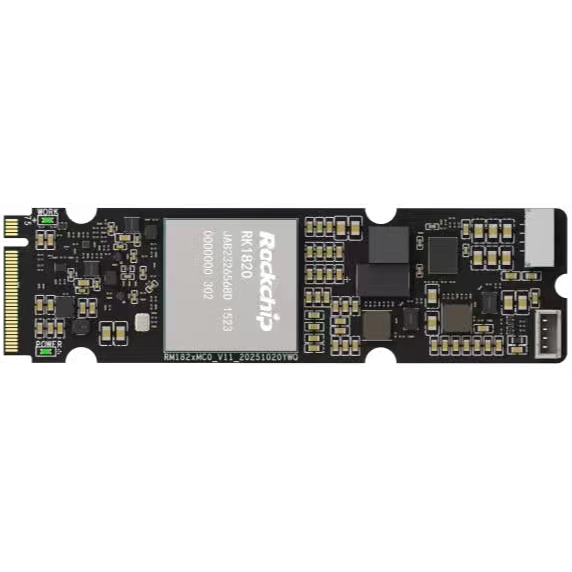
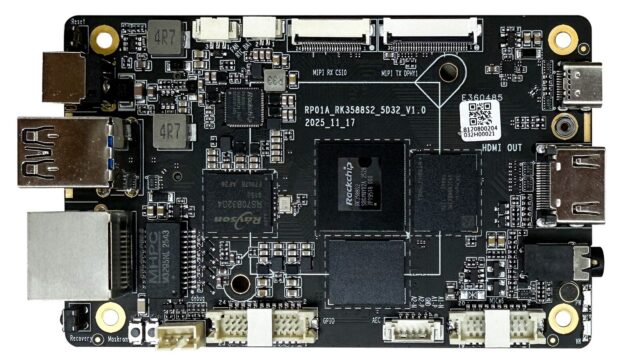
The 01M M-RK3588S system-on-module integrates SoC, memory and storage inside the module, so the module vendor owns the high-speed routing while the carrier handles relatively low-speed peripherals, markedly reducing production risk. The 01A RP01A-RK3588S-5D32 is a board-level design configured with 5GB DDR, suited to form factors going straight to production.
Two easily overlooked points
First, temperature grade. Industrial sites often require minus forty to eighty-five degrees Celsius or wider, and industrial-grade memory and storage differ substantially from consumer grades in both price and lead time. Confirm this early rather than swapping parts after the design is complete.
Second, supply cycle. Memory and storage are the two commodity groups with the most volatile pricing and the highest incidence of discontinuation. Beyond today’s price, ask about the manufacturer’s lifecycle commitment and whether a second source exists.
For network storage products, the storage path also involves PCIe expansion. Boards such as the 04A NAS-RK3588 network storage board are designed around attaching SATA or NVMe over PCIe and dividing labour with on-board eMMC: the system runs on eMMC while data drives go over PCIe.
Conclusion
The order is: check the SoC support list, then determine whether the workload is bandwidth-sensitive or random-IO-sensitive, then confirm temperature grade and lifecycle, and only then compare price. Skipping the first three steps to compare prices directly tends to produce rework later — and rework costs far more than the difference you saved.