01A RP01A: Networking: port count and Wi-Fi generation
Port count and Wi-Fi generation decide the network topology. Gateway, isolation and redundancy are different with one port versus two.
Specifications first: 01A RP01A
| Item | Specification |
|---|---|
| Ethernet | 1000M x 1 |
| Wi-Fi | WiFi5Wi-Fi IEEE 802.11a/b/g/n/ac |
| SoC | RK3588S Octo-core, Cortex-A76 and Cortex-A55; up to2.4 GHz |
| Memory | LPDDR5X; 4G/8G/16G/32Goptional |
| Storage | supports eMMC5.1, SDIO3.0; 16GB/32GB/64G/128G(optional) |
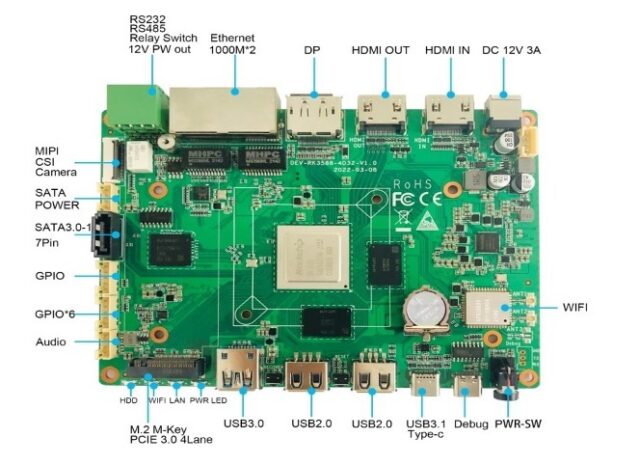
| USB | USB3.1 host Type-A x 1 5 Gbps; USB3.1 OTG Type-C x 1 5 Gbps; USB2.0 host Type-A x 1 480 Mbps |
| Display | HDMI 2.1port x1, up to8K 60Hz, HDCP2.3; Type-Cport x1, 2Lane, up to4K 60Hz, DP1.4a HDCP2.3; MIPI DSI x 2, 4Lane |
| Power input | 12V 2A powerDC barrel jack 5.5 2.0 |
How to read these numbers
Wired networking is 1000M x 1. Port count decides whether isolation or redundancy is possible; speed sets the LAN ceiling.
Wireless is WiFi5Wi-Fi IEEE 802.11a/b/g/n/ac. The generation affects density and power; whether antennas are included needs separate confirmation.
The SoC is RK3588S Octo-core, Cortex-A76 and Cortex-A55; up to2.4 GHz. The chip sets the CPU architecture, instruction set and supported OS; confirm compatibility with your software stack first.
Memory is configured as LPDDR5X; 4G/8G/16G/32Goptional. It bounds application and UI size; pick the tier against the real workload before volume orders.
Storage is supports eMMC5.1, SDIO3.0; 16GB/32GB/64G/128G(optional). The type (eMMC / UFS / SD) matters more than capacity for boot speed and random I/O.
USB is configured as USB3.1 host Type-A x 1 5 Gbps; USB3.1 OTG Type-C x 1 5 Gbps; USB2.0 host Type-A x 1 480 Mbps. Read count and speed together: speed decides which devices work, count decides how many at once.
Display output is HDMI 2.1port x1, up to8K 60Hz, HDCP2.3; Type-Cport x1, 2Lane, up to4K 60Hz, DP1.4a HDCP2.3; MIPI DSI x 2, 4Lane. Check resolution, refresh rate and interface type together, especially for a specific panel.
Power input is 12V 2A powerDC barrel jack 5.5 2.0. Voltage and connector shape drive baseboard design and field supply replacement.
What it means in practice
A single Gigabit port is fine for a gateway or player; dual-port isolation or redundancy needs a different model or a USB adapter.
Wireless is Wi-Fi 5: fine for everyday links, without Wi-Fi 6’s density and power-saving features.
Read it against neighbouring specs
One more angle that is easy to miss: USB does not work in isolation. It interacts with Wi-Fi and Power input. Read them together to see whether the board will hold up in your configuration.
USB is configured as USB3.1 host Type-A x 1 5 Gbps; USB3.1 OTG Type-C x 1 5 Gbps; USB2.0 host Type-A x 1 480 Mbps. Read count and speed together: speed decides which devices work, count decides how many at once.
Wireless is WiFi5Wi-Fi IEEE 802.11a/b/g/n/ac. The generation affects density and power; whether antennas are included needs separate confirmation.
Power input is 12V 2A powerDC barrel jack 5.5 2.0. Voltage and connector shape drive baseboard design and field supply replacement.
Where it fits
Fits terminals with a simple topology where one port suffices; isolation or redundancy calls for a dual-port model.
When not to choose it
If dual-port isolation is required and the board has one port, a USB adapter compromises bandwidth and stability; pick a dual-port model instead.
Check these before ordering
- One port or two, and whether isolation or redundancy is needed
- Wi-Fi generation and antenna routing
- Whether PoE needs an external module
To confirm whether a particular port or power detail fits your device, the specifications and downloads are at https://docs.haimika.com/en. You can also describe your peripherals and scenario at https://www.haimika.com/en/quote/, and we will reply with feasibility and boundaries.