TV Stick or TV Box in 2026: Which Form Factor Fits Your Use Case
With the same budget, should you buy a TV stick or a TV box? There is no single answer, but there is a clear line of reasoning: start with mounting position and thermal conditions, then interface requirements, and only then chip performance. Get the form factor wrong and no specification sheet will save you.
Form factor decides mounting and thermals
A TV stick plugs directly into the TV’s HDMI port and sheds heat in the space behind the panel. Its advantages are that it takes up almost no room, needs no separate spot for a power adapter, and unplugs in seconds when you move. The cost is that the size constraint leaves little thermal headroom, so throttling under sustained load is more noticeable than on a box.
A TV box sits independently with a larger chassis, more relaxed thermal design, and room for more ports and bigger antennas. The trade-off is that it occupies surface area and needs a power outlet.
How three typical models differ
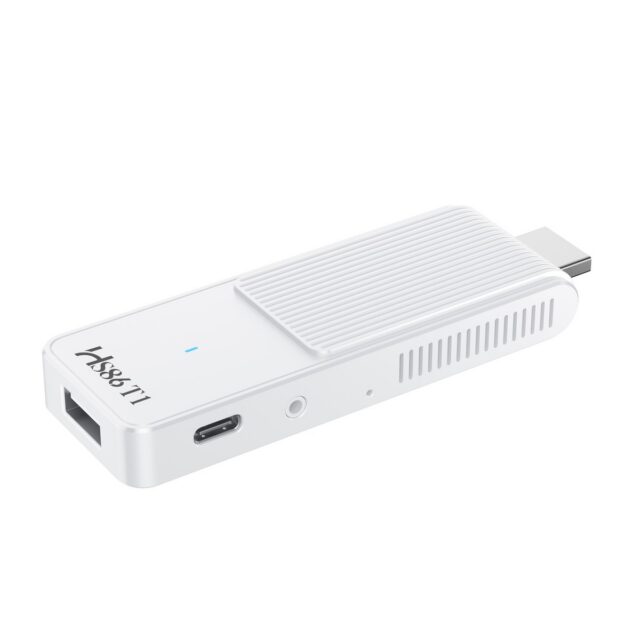
The HS86 T1 TV stick is based on RK3518 running Android 14 with Google GMS, offering HDMI output, an IR expansion header, USB 2.0 and Type-C power, with a voice plus IR remote. Its role is “plug in and go” — living room media and business travel.
The HS89 T15 TV stick is the better-specified member of this family: RK3539 quad-core Cortex-A55 @1.92GHz with Mali-G310, EMCP 2GB+16GB or 4GB+32GB, dual-band Wi-Fi 6, Bluetooth 5.4, HDMI 2.1 output at 4K@60fps with AV1/VP9/H.265 hardware decoding, all in a 100×33×13mm body with Type-C power. AV1 hardware decoding is a key point here — AV1 content has been rising as a share of streaming catalogues over the past two years, and hardware support cuts CPU load substantially.
The X88 PRO T1 Dongle is also a direct-plug design, based on RK3518 with Android 14, 1GB+8GB or 2GB+16GB, 2.4G Wi-Fi (802.11 a/b/g/n/ac/ax), Bluetooth 5.0, a 10/100M Ethernet port, HDMI 2.0b at 4K@60fps, a 102×33.5×13.8mm body and Type-C power. It adds a wired port over the HS86 T1, which is steadier in hotels or meeting rooms with poor Wi-Fi.
Three typical ways to use them
Travel. Hotel TV platforms are often slow and locked down. Carrying a stick lets you plug in and use your own interface and accounts. Prioritise size, power method (Type-C can run from the TV’s own USB port) and Wi-Fi compatibility.
Living room cinema. If the TV is already smart, a stick simply adds a smoother system. If the TV is older, or you need to feed an amplifier or attach storage, a box is far more comfortable on interfaces.
Commercial signage and displays. Wired networking, long-term stability and centralised management come first here. The box form factor is usually the better fit; direct-plug designs are constrained by the TV’s HDMI port power and cooling.
Conclusion
Mobility first, plug-and-play: a TV stick — the HS89 T15 is the most complete on specifications.
Want a wired fallback beyond Wi-Fi: the X88 PRO T1 Dongle is steadier.
Need to drive an amplifier, attach storage, or run continuously: stay with the box form factor.
All three support OEM customisation; specifications and downloads are on the respective product pages.