Multi-Camera MIPI Vision Design: Matching Interfaces, Bandwidth and Compute
In machine vision projects the camera count is usually fixed during requirements, but bandwidth rarely gets calculated first. The result is a board that drops frames as soon as several cameras stream at once — and the bottleneck is not the CPU but MIPI lanes and memory bandwidth.
Lane count is not the same as usable camera count
Each MIPI CSI lane has a bandwidth ceiling, and higher resolution or frame rate consumes more of it. With several cameras in parallel you must watch three things at once: MIPI lane count, ISP throughput and memory bandwidth. Whichever becomes the bottleneck, the whole pipeline drops frames.
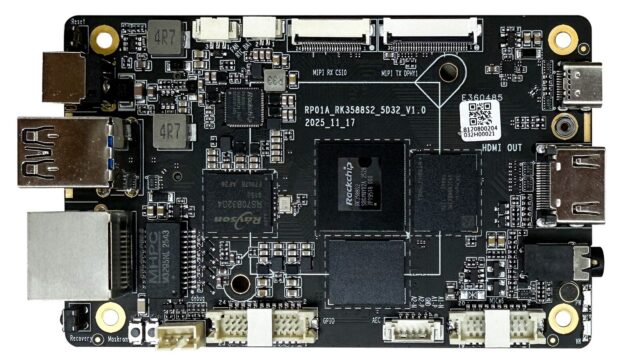
The 01A RP01A-RK3588S-5D32 provides dual MIPI camera inputs and, with the RK3588S eight-core CPU and 6.0 TOPS NPU, suits a two-camera-plus-inference combination. It also carries 6 microphone inputs and 2 AEC inputs, so vision and voice can run side by side.
Compute must be sized together with camera count
A common mistake is fixing the camera count first and then hunting for a board. The better order is the reverse: establish the inference frame rate needed per camera, multiply by the number of cameras to get total inference demand, then pick a platform against NPU capability.
Where camera count and model size are both substantial, the 01B EDGE-RK3588-4D32 V1.2A with its eight-core RK3588 and 6 TOPS NPU is the safer starting point, and it ships with complete interface, flashing and functional test documentation.
Industrial sites add further constraints
Interference, vibration and temperature on a workshop floor all affect camera stability. For deployment on a production line or in an outdoor cabinet, the wide-temperature design (-20℃ to +70℃) and isolated interfaces of the 05A IPA-RK3588 industrial control board are a better fit. It also offers HDMI 2.1, MIPI-DSI and dual-channel LVDS, so display and vision can be planned together.
The recommended order
Estimate bandwidth first, match compute second, choose the board last. That sequence avoids most cases of “we bought it and it will not run”. Specifications are on the RP01A-RK3588S product page.