How to Read an Embedded Board Quotation: BOM, Tooling, Certification and Volume Pricing
The most common reaction to an embedded board quotation is “that is more than I expected” — and that judgement usually comes from not seeing how the number is built. The same board quoted at 100 units and at 5,000 can differ substantially, and not all of the gap is margin. Taking the quotation apart is what tells you which parts are negotiable and which simply are not.
Every Line Falls Into One of Three Buckets
Whatever the format, embedded hardware pricing is built from three things: material cost (BOM, scales with quantity), one-off charges (NRE, independent of quantity), and manufacturing and test cost (varies per batch). Mentally splitting a total into these three resolves most of the confusion — for example, the reason unit price looks absurd at low volume is usually that one-off charges are being amortised over very few units.
BOM: SoC, Memory and Storage Dominate
Within the bill of materials, the main SoC, memory (LPDDR4X/LPDDR5) and storage (eMMC/UFS) usually account for the overwhelming share — together often more than half of material cost. That means the configuration tier sets the price step: on the same board, moving memory from 4GB to 8GB, or storage from eMMC to UFS, shifts unit price more than many buyers expect.
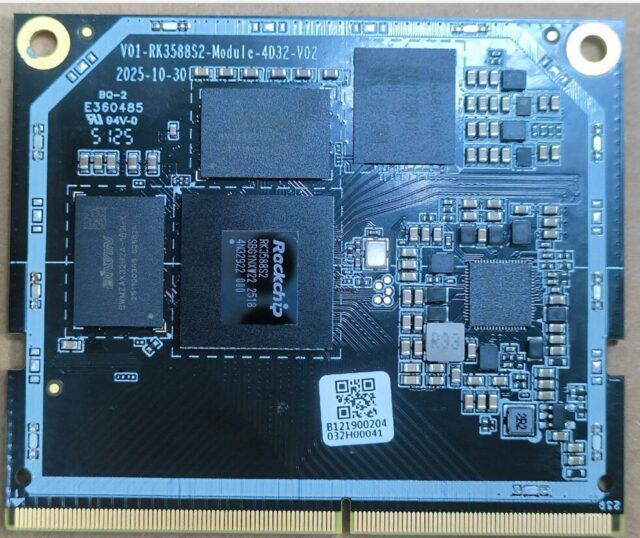
Which also means that when budget is tight, looking at configuration tiers is more productive than simply pushing on price. Listing “required” separately from “nice to have” at selection stage lets you price the trade-off immediately. A board with a comparatively fixed interface set and configuration, such as the 05A IPA-RK3588 工业控制主板, produces a far clearer quotation structure than a fully custom design; while for something like the 01M-M-RK3588S 核心板, you need to establish whether carrier board design is included in the same quote.
One-Off Charges: Tooling, Fixtures, Certification, NRE
This is the part most often overlooked, and the most common source of misunderstanding. Tooling covers mechanical parts (enclosures, brackets) and only appears when the mechanics change. Fixtures are jigs for production and test, amortised over volume. NRE (non-recurring engineering) covers schematic changes, PCB respins and low-level software adaptation. Certification depends on which markets you must satisfy.
The key point: one-off charges do not scale with quantity. In a low-volume project they dominate unit price, which reads as “being overcharged.” Once that is clear, the negotiation changes shape too — rather than demanding NRE be waived, it is better to confirm which changes are genuinely necessary.
Volume Pricing: Why 500 and 5,000 Differ So Much
Unit price falls with volume for three reasons: component purchase prices drop in tiers, line changeover and bring-up cost spreads thinner, and one-off charges are divided by a larger base. These three carry different weight in different ranges — the drop from 100 to 1,000 units is usually the steepest; beyond that it flattens, because the dominant cost has become the materials themselves.
So if volume is expected to grow, it is worth asking for the full tiering at first quote rather than a single number. For a product with an established standard form factor such as the 02A EDGE-RK3576 V1.1, the tiers tend to be stable; a custom design needs each band confirmed.
What Is Negotiable, and What Is Not
Comparatively negotiable: rebate or credit of one-off charges once volume materialises, payment terms, where the tier boundaries sit, and delivery scheduling. Comparatively fixed: the SoC’s own purchase price (driven by the upstream market), certification fees (levied by third parties), and any unit price clearly below reasonable material cost — the last of these, even if agreed, raises the risk of problems later in component substitution or quality.
How to Compare Quotations
Formats vary enormously between suppliers, so comparing headline numbers is a trap. Reduce every quote to the same table: material unit price, itemised one-off charges, tiered pricing, payment terms and lead time, warranty terms. Once normalised, the “cheaper” quote often reveals itself in one-off charges or warranty conditions. Send the interface list, quantity and required lead time together — only then are the quotes actually comparable. The more complete the input, the more accurate the quote, and the fewer rounds of clarification.