System-on-Module or Single-Board Computer? Choosing an RK3588 Platform for ODM
One of the most underrated decisions at the start of a hardware project is whether to use a system-on-module or a single-board computer. Early on it looks like a question of form factor, but it directly determines whether the next six months go into business logic — or into power tree design and DDR bring-up.
What actually separates them
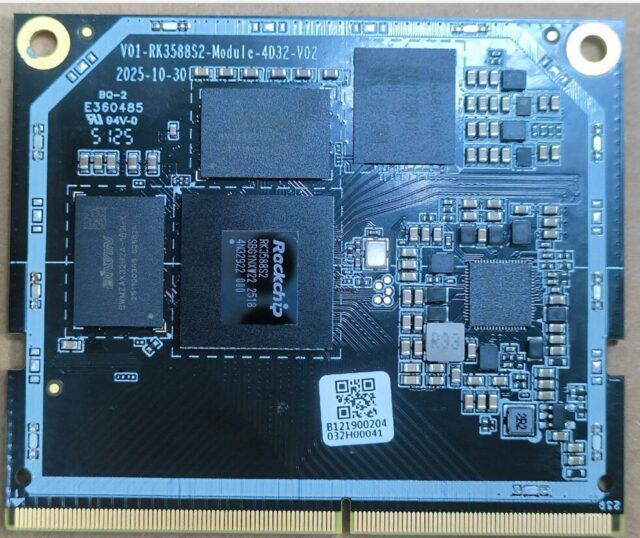
A single-board computer is a complete board: SoC, memory, storage, power and interfaces all on one PCB. Power it up and it runs. A system-on-module packages the parts that are essential but hard to design — SoC, memory, storage — into a small module, exposes functional interfaces through a connector, and leaves the customer to build a carrier board for the peripheral circuitry.
Take the 01M-M-RK3588S SoM as an example. It routes all of the RK3588S functional interfaces out to a DDR4 SO-DIMM connector. SO-DIMM is a mature standard connector, which means the carrier board can be built with ordinary processes and you never have to handle BGA assembly or high-speed signal integrity yourself.
When a SoM is the right call
When a project needs its own enclosure and interface layout, and volume is expected to be meaningful, a SoM is the more sensible route. Doing a high-density BGA package such as RK3588S yourself means investing in high-speed routing, impedance control and DDR training and debug as a complete skill set — months of work and multiple board spins for a small team.
SoM designs also iterate faster. Upgrading memory capacity or switching SoC model often means changing only the module while the carrier board carries over.
When a single-board computer gets you there faster
If the priority is validating an algorithm, building a prototype, or running limited volume, buying a single-board computer is simply the most efficient path.
The 01A RP01A-RK3588S-5D32 is built on RK3588S (8nm, eight-core 4×Cortex-A76 + 4×Cortex-A55), supports 8K 60Hz video output and decoding, and includes a 6.0 TOPS NPU. Its interface set leans toward vision and voice: dual MIPI camera inputs plus 6 microphone inputs and 2 AEC echo-cancellation inputs. Projects doing video object recognition or voice interaction can use these directly, saving peripheral design work.
The 01B EDGE-RK3588-4D32 V1.2A takes the standard edge computing development board route: eight-core RK3588, 8K encode/decode, 6 TOPS NPU, 4GB DDR with 32GB eMMC, and a complete set of interface, flashing and functional test documentation. It works better as a general validation platform.
How to assess compute requirements
The RK3588 family carries a 6 TOPS class NPU — enough for video structuring, object detection and face recognition, but not enough to run large language models. Before choosing, pin down whether local inference is actually needed, and what model size and frame rate are required. Only then decide between an NPU-equipped platform and a lower-cost platform paired with cloud inference.
Development cycle and production risk
A practical test: if nobody on the team has done DDR routing, the upfront investment in a SoM approach will run well above expectations. Conversely, if the product is already committed to a long iteration cycle with annual volume in the thousands, the cost advantage of your own carrier board will recover the development spend quickly.
Full specifications, interface documentation and flashing guides for the SoM and development boards are on the 01M-M-RK3588S product page.