RK3576 for Edge Computing: Finding the Middle Line Between Performance and Power
When an edge computing project moves toward deployment, the question that comes up most is not “which chip” but “why can’t we just use an industrial PC”. Behind that lies a more practical choice: between a development board and a finished box, which form factor suits the site you are actually deploying into.
Three tiers of edge requirements
Sort common edge projects by compute demand and they fall into roughly three tiers: data acquisition and protocol conversion, which needs almost no compute; light inference such as face recognition, object detection or anomaly detection; and simultaneous multi-stream video analysis or a local small model.
The first tier is satisfied by a low-power quad-core platform. The third generally requires the RK3588 class. The second — which is also where most projects sit today — is exactly where RK3576 belongs.
Where RK3576 sits
The 02A EDGE-RK3576 V1.1 is an edge computing development board built on Rockchip’s RK3576. RK3576 strikes a good balance between performance and power: clearly above entry-level quad-core options in compute, yet far lighter on power draw and thermal pressure than a flagship eight-core platform. For projects that run unattended for long periods, or sit in cabinets with ordinary cooling, that balance point is worth more than peak performance.
The board carries a reasonably rich set of on-board interfaces and ships with a complete hardware specification, interface description, flashing guide and downloads. At the validation stage, documentation completeness often decides project schedule more than raw specifications — what it saves is the time spent reverse-engineering interface definitions.
When to move up to RK3588
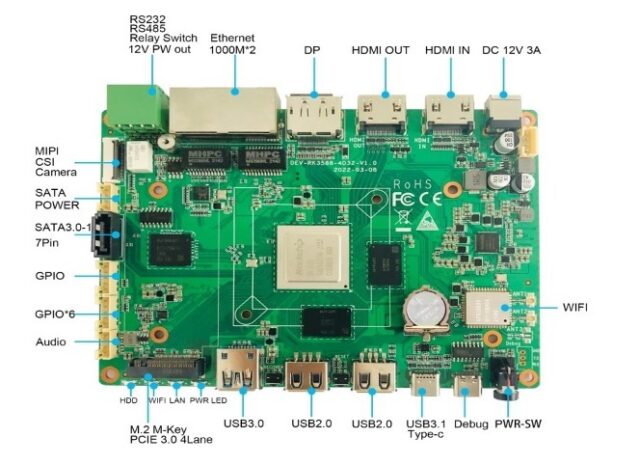
If a project needs more than eight concurrent video analysis streams, or has to run a larger model locally, it is time to look at the RK3588 platform. The 01B EDGE-RK3588-4D32 V1.2A offers an eight-core CPU, 8K encode/decode and a 6 TOPS NPU with 4GB DDR and 32GB eMMC — a fairly standard validation platform for that tier.
Form factor: development board or mini PC
Development boards win on interface coverage, expandability and ease of debugging — ideal for R&D and validation. But at an actual deployment site, a bare board is awkward in terms of dust protection, power, cable routing and appearance.
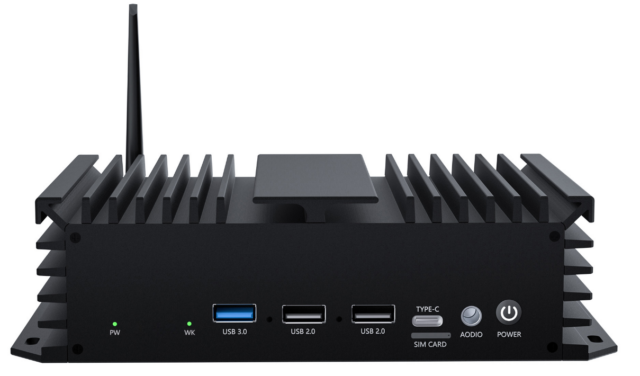
The 01H MINI PC-RK3588 is the same compute tier in another form: an RK3588-based mini PC / edge computing box that balances performance and size, suited to desktop terminals, edge servers and digital signage, and supplied with hardware specification, interface description and flashing documentation. Its value is settling the engineering work between “validation complete” and “racked and running” ahead of time.
Practical advice
Validating algorithms and interfaces quickly on a development board during R&D, then switching to the box form factor for production or deployment, is the common path in this industry. The key is to align interface definitions between the two at selection time, so you are not re-adapting later because they differ. Specifications and downloads are on the EDGE-RK3576 V1.1 product page.