From Sample to Mass Production: Six Stages of Embedded Hardware Procurement
Anyone buying embedded hardware for the first time tends to assume the flow is “pick a model — place the order — receive it.” In real projects there are usually six stages between evaluation and mass production, each with a different set of things to confirm. Skipping one rarely costs a week; it usually means the problem surfaces at volume, where rework is multiplied many times over.
Stage 1: Requirement Alignment (Cheapest Step, Most Often Skipped)
Before discussing models, write down three things: the interface list (how many Ethernet ports, serial ports, USB, display outputs, and to what spec), the environmental envelope (temperature range, supply conditions, mounting), and volume and cadence (first batch size and expected annual volume). That list is not just for you — it determines whether a supplier can quote accurately first time, and it sets the efficiency of every conversation that follows.
Stage 2: Selection and Evaluation Boards
Selection follows the requirements. The goal here is not “the best” part but one whose interfaces and ratings are sufficient and whose supply is stable. Evaluation boards exist to prove the software stack and peripherals work, not to substitute for a judgement about final form factor. Note that evaluation boards usually expose every interface; a production unit may be configured differently, so do not mistake evaluation-board convenience for shipping capability.
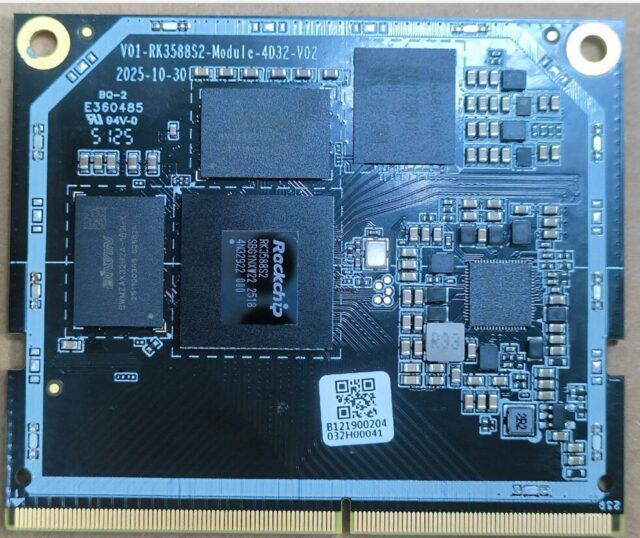
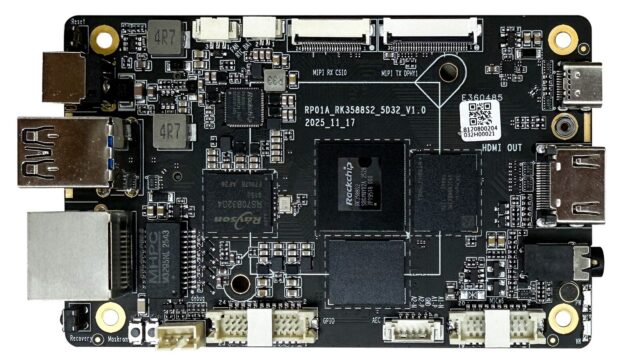
A development-board form factor such as the 01A RP01A-RK3588S-5D32 suits early validation; where compute and memory demands are higher, a higher-specification model like the 01B EDGE-RK3588-4D32 V1.2A sits closer to production reality.
Stage 3: Sample Validation (Function, Environment, Compatibility in Parallel)
The classic sample-stage mistake is testing function only. Passing functional tests is the entry ticket; the time actually goes into two other tracks: environmental validation (high and low temperature, sustained full load, supply fluctuation) and compatibility validation (whether the cameras, displays and peripherals you intend to use genuinely work reliably). Peripheral compatibility especially should be finished at sample stage — it is the hardest thing to fix later, because it involves third-party hardware.
Stage 4: Pilot Run
A pilot run (typically tens to a few hundred units) exists to prove consistency: does behaviour hold across batches and across individual units. What you are looking for is process variation — thermal behaviour, connector feel, boot-time uniformity. One good sample does not guarantee the hundredth unit behaves the same, and this step is what exposes that.
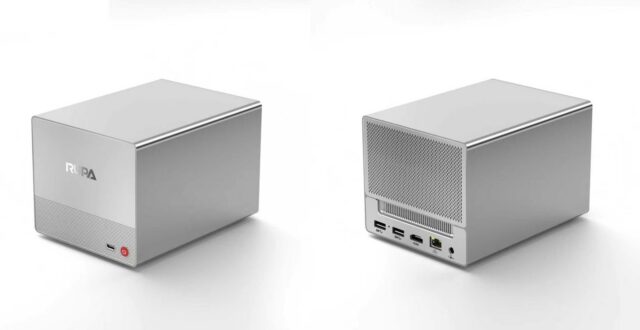
It is also the last opportunity to validate the non-technical things that still go wrong: packaging, documentation, serial number management. For a product whose form factor is already fixed, such as the 01H MINI PC-RK3588, this step is relatively light; for a custom design it is mandatory.
Stage 5: Mass Production and Ramp
At volume the focus shifts to component locking and change control. Once production starts, any substitution should go through notification and validation, or you end up with “two versions of the same model” — a maintenance landmine. Confirm the ramp cadence too: whether supplier capacity tracks your growth, and how long critical components take to replenish.
Stage 6: Change Management and Long-Term Supply
After launch comes the genuinely long phase. Agree three things in advance: change notification (how far ahead hardware revisions are announced), end-of-life notification (EOL lead time and last-time-buy window), and spares availability (whether repair units remain purchasable after discontinuation). Negotiating these at purchase time costs almost nothing; negotiating them when you need them usually leaves no room.
Treated as a checklist rather than a flowchart, these six stages are far more useful — before entering each new stage, check that the previous stage’s confirmations actually landed, and you avoid most of the trouble that otherwise erupts after volume production.