Deploying Models on the RK3588 NPU: From the RKNN Toolchain to Real 6 TOPS Throughput
Between the “6 TOPS” on a specification sheet and the frame rate you actually get lies an entire toolchain. Plenty of teams buy an RK3588 board only to discover that whether a model ships depends on conversion, quantisation and operator support — not on that number.
First, what 6 TOPS means
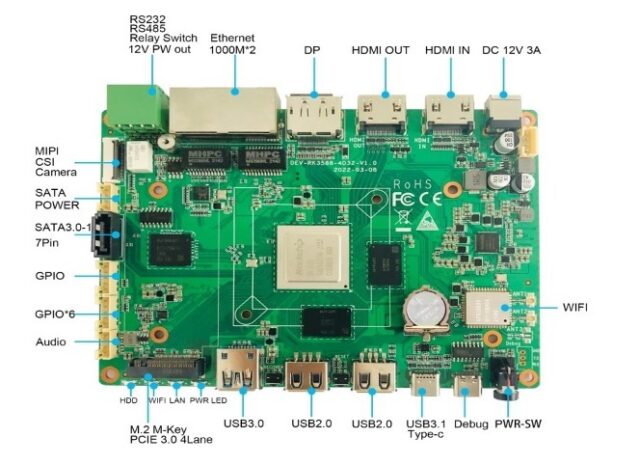
The RK3588’s built-in NPU delivers 6 TOPS with RKNN and TensorFlow Lite support. The 01B EDGE-RK3588-4D32 V1.2A pairs an eight-core CPU and 8K encode/decode with that NPU, plus 4GB DDR and 32GB eMMC — a fairly standard validation platform.
The realistic positioning of this tier: small and mid-sized models such as object detection, face recognition, video structuring and pose estimation run comfortably; large language models do not. Confirming model scale before selection saves far more time than optimising afterwards.
The toolchain is the real barrier
The RKNN workflow runs model (exported from ONNX / TensorFlow / PyTorch) to conversion to quantisation to on-board inference. Each step has places to get stuck. Quantisation matters most: INT8 quantisation speeds things up substantially, but whether the accuracy loss is acceptable must be measured on your own dataset, not inferred from generic benchmarks.
Operator support is another common issue. If a model contains operators the NPU does not support, they fall back to CPU execution and those few operators end up throttling the whole pipeline. The usual fix is rewriting the network structure rather than forcing it through.
Matching interfaces to the use case
The 01A RP01A-RK3588S-5D32 is built on RK3588S (8nm, eight-core 4×Cortex-A76 + 4×Cortex-A55), supporting 8K 60Hz output and decode with a 6.0 TOPS NPU. Its interfaces lean toward vision and voice: dual MIPI camera inputs plus 6 microphone inputs and 2 AEC echo-cancellation inputs. Projects doing video object recognition or voice interaction can use them directly, saving peripheral design work.
Practical advice
The sensible order is: get a minimal working model running on an off-the-shelf board first, solving toolchain and accuracy issues, then consider custom hardware. Doing it the other way round often means discovering the model will not run after the hardware is already fixed. Specifications and downloads are on the EDGE-RK3588-4D32 product page.